© Uta Pippig and Take The Magic Step®
Cross-Training—Swimming, Deep-Water Running, Cycling, and Cross-Country Skiing
December 30, 2012
Dear Friends,
Today’s message is mainly about trying to get the best out of your training in case Mother Nature is making it difficult to run outside—especially when snowy conditions might prevent you from keeping to your training plan. I will share another message with you in one week or so with a few key points about running on a treadmill.
I hope you have enjoyed a most wonderful holiday season so far, and I wish you a magical start to the New Year. May it bring everything you hope for in your fitness, training, and personal life. I can’t thank you enough for stopping by and joining me here at Uta’s Insights, and of course, for visiting our Website.
My best wishes go out as well to our charity partners. To the Hoyt Foundation with Dick and Rick Hoyt and Kathy Boyer, to the wonderful team of the SOS Outreach organization with Arn Menconi and Seth Ehrlich, to our friends of “PeopleWeaver,” the Louisa May Alcott Orchard House, and the Kinderhilfe in my home town in Germany. Once again your tremendous work and your caring has been our inspiration.
This past year was exciting for us here at Take The Magic Step—and now I hope I can share the excitement for the new year as you travel on your path to more fitness and health, and maybe prepare to run your marathon.
The biggest concern many of you might have is how to deal with the cold winter weather and the prevailing outside conditions during your training. Oh, I so wish I could send all you runners who are dealing with cold weather some sunshine—and blow you some warmer temperatures from here in New Zealand. All right, that will not work! We know that sometimes your runs will be difficult, with the snow and the cold and the wet, and those of you who have to run in the dark of winter face an additional challenge.
Try picturing the home stretch of your marathon and imagining the joy you will feel as you cross the finish line. It may help you find the energy to deal with whatever Mother Nature throws your way. You might even try smiling up at her and saying, “Ha! You won’t get me today!”
Cross-training can be very beneficial if added to your running schedule. Please, make a wise decision at this stage of your marathon preparation about which training alternative is best for you when you need to adjust your training due to wintry conditions. Many of you are used to triathlon training, so you know well what can be done to combine your running schedule with proper cross-training like swimming or bike training. But let me pass on a few quick and practical thoughts about cross-training since this is an often occurring topic when I am coaching my friends and clients from many parts of the world. Cross-training also is included as one of the 12 Key Points in my article “General Guidelines for Your Marathon Preparation,” and here it is again.
© Betty Shepherd
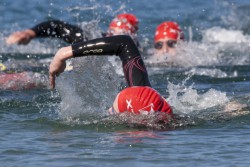
Swimming, for example, can help you to recover from a long run or a tempo workout, and at the same time improve deeper breathing. It is a great tool to enhance overall fitness and stamina as well. You can either work on endurance with longer sessions in the pool or speed endurance by doing interval programs.
Deep-water running is another great addition to your training routine. Here, you use your running muscles while simply running in the water with a flotation vest. At the same time, depending on the intensity of the workout, you will be supporting your cardiovascular system. It is also an effective training tool that can be helpful in recovering from a number of injuries—but, like everything else I recommend, check in with your physician first to make sure that water running is appropriate for you.

© Uta Pippig and Take The Magic Step®
Depending upon where you live—and I know many of you had a lot of snow lately—you also might enjoy adding cross-country skiing. You may find it useful to check “Cross-Country Skiing: A Great Option for Winter Fun and Fitness” to review how this training can improve your aerobic endurance and strength. It is one of my favorite activities and it allows me to stay within my planned training schedule with a similar workout on my cross-country skis. It helps me to build endurance and muscular strength for my next phase of training, which is aimed specifically at getting in good running condition.
Cycling is another option, too. It also will help improve your aerobic endurance, although compared to cross-country skiing or deep-water running it involves fewer of the same muscles as running. So while it is essential for triathlon preparation, it is less effective for your marathon training. As you get closer to the marathon, try to switch more and more of your bike training time into actual running time. It will help you to get the most out of your training and will get you in top shape for your marathon run.

© Betty Shepherd
If you can’t bike outside, some of you might be able to attend spinning classes. This provides a good workout at this stage of your marathon preparation.
However, as you get closer to two months before your marathon, I would keep focusing on running more and more for your primary training, and only “spike” it with some biking or deep-water running. Meanwhile, your swimming routine can stay the same up until the last few weeks before the marathon.
A quick note about some additional supportive training elements for running: Core strengthening and light weights. Core strengthening will help you condition the muscles that stabilize the spine and pelvis and the muscles that hold the torso. Because of this, exercises should include more than just sit-ups. It is best to add “Plank Exercises” and “Side Plank Exercises” as well. You also can use the medicine ball for extended exercises. And try Pilates—as many of you already have. These are all great workouts.
When you add a session with light weights, it is best and most effective if you concentrate on exercises that will strengthen your running muscles. The combination of light weights and core work, with a minimum of one workout each per week, will greatly help your running performance. Triathletes and advanced runners: make sure to create your own specific training schedule with further workouts.
On a practical note, right after your run in cold conditions or if you feel cold after your workout, please change into dry clothes as soon as possible to stay warm and avoid getting a cold. I had a few forced days off during my own marathon preps simply because I forgot to bring a spare pair of socks or a dry sweater. It is helpful to bring a towel, a warm jacket, and even some nice warm tea or coffee in a thermos in case it takes some time to drive home from your running location. And when you get home, take a warm shower. Also, it might be a good idea to check out the latest winter gear for running—or other endurance sports—in one of your local running stores.
And finally, when it is very cold and snowy, running inside on a treadmill is a great alternative. As I mentioned earlier, I will pass on a few key recommendations for treadmill training shortly.
Much of this advice was accumulated during my career in running and I hope it will be as beneficial for your training as it was for mine. Feel free to get back to me via my Facebook page to let me know if you have additional questions about cross-training or related topics.
Keep running on happy trails. I wish you a happy New Year and good luck in your training!
Warmest regards,

Updated December 28, 2013
- Posted December 30, 2012
© Copyright 2012-2026 by Uta Pippig. All Rights Reserved.
More Insights
October 13, 2020

Uta’s Favorite Exercises to Improve Your Fitness and Running Technique
Uta Pippig has designed an at-home fitness program which only uses your own body weight, steps, and a Theraband. They are eight exercises that Uta often does herself.June 29, 2018
Uta’s Yoga and Stabilization Guide for a Better Running Technique
Runners, especially, can benefit from a well-balanced yoga and stabilization program. Uta suggests effective combinations of poses and exercises that have helped her gain the flexibility and balance that can lead to a better running technique for everyone.May 15, 2018
How a Clever Mental Focus Can Get You Through Running Injuries
Running injuries can be devastating, but learning to focus mentally can speed up the healing process. Uta explains how the forced break from running can actually provide future benefits.October 7, 2015