Yoga for the Right Balance
Yoga: Another Form of Exercise and Healing
Yoga and Running Go Well Together
Yoga for Performancesm and Yoga Styles
Uta’s Yoga Practice
Ultimate Alignment of the Body

Creating a harmonious relationship with your body is a vital part of a healthy lifestyle and a continuing topic on which many of us like to focus. Being aware of what we eat, physical fitness, and finding a unique path to wellbeing has become essential to our lives. It is a beautiful trend, and I applaud you, too, for exploring this wonderful path of living!
Yoga can help us be and feel more fit and healthier. It can add a welcome component to other types of exercise we already enjoy. Yoga has become one of my newest training aids and now is an integral part of my daily fitness routine.
Many of you, dear readers—and a number of my clients and athletes I work with—seem to enjoy the practice of yoga as well. You have given me wonderful feedback about my program, “Yoga for Performancesm.” I thought it was time to reflect again on this ancient Indian science of exercise and healing, and discuss in more detail how to integrate it into your fitness routine.
Those of you who already are familiar with yoga probably understand its many benefits. You can find extended information in another article in the Yoga section on this Website. For now, I would like to give you a quick overview about how you may find yoga to be beneficial. I also would like to share how yoga and running can complement each other, and how yoga can support you in your efforts to be best in your favorite sport. Towards the end of the article, I will introduce you to three elements of my typical routine, and how to add yoga practice to your schedule.
The following thoughts include some of the results of my own search for the right balance in the intensity of my training, what I have learned from following yoga studies, and my own yoga routine. Yoga practice with my clients and athletes has also helped broaden my knowledge and appreciation of this physical and mental art. I hope this can provide inspiration and guidance that will help you to improve your fitness, health, and quality of life.
Searching for Yoga: Another Form of Exercise and Healing
I came to yoga after many years of competing in sports at the highest level. In 2000 I was still training for elite events, but I found myself exhausted, missing my usual strength, energy and sense of harmony. I felt increasingly tired and emotionally drained, and on top of that, I was dissatisfied with my fitness routine.
Athletes are used to an unusually intense training routine—their bodies are constantly called upon to function at the highest levels of performance. Many like to explain it as a “walk on the edge”—living with the ever-present risk of getting injured or sick due to the enormous workload imposed on their bodies.
I was certain one component in my life was missing: a counterpart to the fiery, aggressive “Yang” in which I was submerged. I was looking for the more introspective “Yin”—a resting pole and the “quiet” side of my training routine—that would allow me to stay healthy and energized. More holistic forms of healing like Yoga and Chinese medicine, had always interested me, but now I began to pay more attention to them. I busily looked for new ideas that would restore the sense of balance I was accustomed to having, so I was very curious and enthusiastic when I began practicing yoga in the spring of 2001.
Yoga and Running Go Well Together
Right from the start, yoga filled me with so much enthusiasm and joy. I was surprised at how much I liked it and how time-effective it was. I found I could stretch out my body, deepen and relax my breathing, and support my spirit—all at the same time. It also brought other practical elements together. Through yoga we can learn to experience the body, mind, and spirit as one. This promotes calmness, harmony, and the correct alignment of the body. The practice of yoga is especially interesting for the sportsman or sportswoman, since it provides an interplay of stretching, stabilization, breathing exercises and meditation.
From the beginning, I could feel yoga and running complemented each other in a wonderful way. On one hand, running promotes the endurance needed for the yoga exercises as the body becomes more stable and strong. It allows you to practice yoga with more stamina and a longer “breath.” At the same time, yoga stretching, relaxation and breathing exercises can be specifically supportive for any sport you enjoy, and easily integrated into your running schedule, or any other athletic training plan.
It was only a matter of time before yoga became the Number One support for my running routine, alongside other training elements like stabilization programs, swimming, deep-water running, cross-country skiing, and biking.
In the beginning, I chose to perform the yoga exercises (“asanas”) very slowly so as to understand the proper way to align the body. I was particularly interested to learn about the role yoga can play in preventing injuries. I discovered how helpful some of the exercises are for warming-up or cooling-down from other workouts, such as a running session. Now I love to use yoga exercises for speeding up the recovery from a workout. I have found benefits even when I was injured, although I always like to discuss the situation with my physician. So, please be careful and get proper advice from a specialist in case of injury!
Breathing exercises (“pranayama”) promote energy, greater oxygen intake, and deep relaxation in the form of meditation, which can prepare the athlete for competition, an upcoming training session, or—at the other end of the spectrum—simply help the body to wind down. These are only a few of the benefits of yoga for athletes. I hope you can discover them for yourself.
At first you may not think that the holistic philosophy of yoga would complement the competitive nature of athletics, but it does—and in such a wonderful way. Yoga teaches focus, self-awareness and self-appreciation—all qualities that benefit the athlete—creating harmony from within. By using yoga’s philosophy to become less judgmental and critical of ourselves, it is possible to bring a better balance to our training. Sometimes we might tend to train too hard and spend too little time on recovery, so practicing yoga can help you find the right balance for your training—and maybe even for your life.
Yoga for Performancesm and Yoga Styles — Thoughts for Yoga Newbies

Yoga stretching exercises and breathing techniques became and still are an integral part of my daily fitness routine. You can find these exercises (asanas) in the article series specially designed for yoga beginners, “Yoga for Performancesm: Introduction(1), Part 1(2), and Part 2(3).” I also included extended exercises for runners. In the articles, I guide you through a yoga stretching and stabilization program, concentrating on those body target zones you use most. In general, “Yoga for Performancesm” promotes complete muscle alignment, stronger ligaments, and greater flexibility to help recover from your workouts and prevent injuries. In addition, you can choose different sequences of asanas to help you warm-up for a workout or to cool-down and subsequently restore energy. Equally important is they also promote body awareness and concentration.
In the beginning, I mostly enjoyed yoga stretching after long running workouts or on easy days of training to recover and relax my tired muscles. Over time, my routine developed into more demanding exercises for stabilization and increased body strength, usually carried out on easy workout days. I took my time in choosing new yoga exercises. Sometimes it was not easy to become familiar with them.
Over a period of more than a year, I learned to fit different sequences of asanas into my running schedule. I enjoyed creating my own, very individualized program (you can follow parts of it in the three links I provided earlier). I also added breathing techniques to my daily routine—in the morning to start the day and also to relax after very intense training.
As with all elements of training, you add to your routine: it is best to take your time and go step by step to allow a natural process of finding the right balance between doing too much and not challenging yourself enough. Maybe you, too, can enjoy taking a step into new territory to supplement the training routine with which you are already familiar.
The body has wonderful ways to tell you when what you are doing is right or wrong, but there is no substitute for training under a competent teacher when you begin. In summer of 2004, I searched for guidance to learn more about body alignment and the traditional healing yoga philosophy, developed in India 5000 years ago and still practiced all over the world. I was curious and needed help in understanding the proper execution of certain asanas. I also wanted to improve my breathing exercises and add a new component to my routine: relaxing techniques in the form of meditation.
I enjoyed private instruction as well as training in groups, which is a completely different dynamic, while also meeting many wonderful people along the way. I was fortunate to train under the guidance of experienced teachers in the style of Anusara Yoga(4). Later I added other yoga styles as well.
Anusara, which means “flowing with grace,” is a heart-centered practice that focuses on an expression of self-acceptance, boundless connection, and joy. This yoga practice became especially interesting to me because of its focus on the correct alignment of the body—unique for each individual and summarized in Anusara’s Universal Principles of Alignment™(5).
Of course there are many yoga styles to choose from, such as Iyengar, Ashtanga, Bikram, or Kripalu Yoga, just to name a few. I strongly recommend you take your time before beginning a yoga program. Check out the column “Yoga Styles” on our Website(6,7,8) and search for a qualified instructor in your area. It is really interesting and fun to learn about different yoga styles. Experiment with different ones, decide which style is most suitable for you, and please, always progress slowly and easily.
Uta’s Yoga Practice
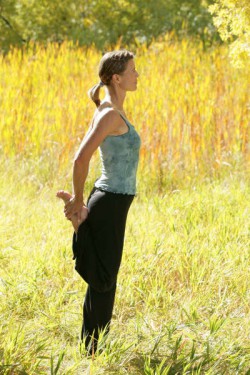
A yoga routine can incorporate three components: asanas (postures), pranayama (breathing techniques) and meditation. I included all three. For me, yoga mostly means practice and recovery at the same time. I use yoga both as a “calming down” and recovery tool as well as a rejuvenating and energizing practice. When using it for recovery, yoga becomes less about athleticism. In this case, I exercise at a slow pace while moving through the yoga program to focus on deep breathing and proper body alignment.
The asanas I practice are focused on stretching the typical target zones for runners, such as opening up medially rotated shoulders and loosening up tight psoas muscles, tight hips, hamstrings, calves, and the Achilles tendon—all with the goal of increasing flexibility, improving strength, and achieving deeper breathing via “chest openers.”
A good place to start is with 15 to 20 minutes of asana practice up to three days a week. You can find the exercises in the Yoga for Performancesm series mentioned above and in Uta’s Insights. Check the archive on the left hand margin under “Show recent posts,” go to the year 2014, scroll down the page. These 15 exercises are part of my yoga routine.
It is advisable to start with only 6 or 7 exercises, and over a period of several weeks add as many exercises as you feel comfortable including. Later, you can add 5 minutes each of pranayama and meditation for up to three days a week. Please find a qualified teacher to give you guidance and feedback to make sure you are exercising correctly, and to help you add breathing exercises as well as meditation!
Eventually you might want to try my current program, which is:
Asanas: 30-40 minutes on 5 to 6 days per week. That means yoga stretching as well as stabilization (depending on my running schedule, see more details below),
Pranayama: 20 to 25 minutes 6 days per week (see more details below),
Meditation: 15 to 20 min 5 days per week, especially after a hard workout or stressful day.
I try to fit all three components into my training routine, choosing different sequences of asanas depending on the intensity of my running workout. On easy running days, I try to incorporate more advanced and demanding asana right after I finish my easy run, to aid stabilization and to build up body strength. On intense running days, I focus on easy yoga stretching with relaxing asanas as well as breathing and meditation. On these days I run in the morning and practice yoga in the afternoon.
Important note about asanas: Avoid yoga stretching right after a very intense workout because very tight muscle structure and loss of body sensitivity can lead to injury while practicing yoga. So, please give your body at least 5 to 6 hours rest after intense training before your next stretching or yoga program.
Important note about breathing exercises and meditation: Please work only with a qualified teacher! He or she will help you to add pranayama into your routine. You will learn how to use inhalation and exhalation for each of your exercises, and how to deploy different pranayama techniques. Yoga meditation requires a long training process. I hope you will enjoy the journey to a higher state of consciousness.
Ultimate Alignment of the Body
The goals are to enjoy your training, find the right balance, stay healthy, and achieve the ultimate alignment of the body as well as mind and spirit. Yoga can help you know your body better and heighten your communication with it. In so doing, you will be able to use the improved alignment as well as the harmony of the body to achieve the best possible flow of energy. Perhaps it can be contrasted with acupuncture, in which the energy channels are opened up and aligned. With yoga, the body’s energy is regulated and muscles and ligaments are aligned, stretched and strengthened—all in a gentle way.
In addition, greater awareness of breathing will improve your mental capacity and the ability to deal with your emotions. Deeper breathing improves the energy supply and helps you to recover more quickly. These latter benefits of yoga have been proven to be beneficial in stress management and daily training.
An Indian proverb says: “The length of someone’s life is not measured in years but in how many breaths they take.” May you enjoy a long, healthy, and fulfilling life!
I wish you the best of luck and much fun when you start your yoga routine.
Namaste,

References:
(1) Uta Pippig and Take The Magic Step®: Yoga for Performancesm: Introduction. www.TakeTheMagicStep.com/Yoga/Yoga-for-Performancesm-Introduction, updated November 2011.
(2) Uta Pippig and Take The Magic Step®: Yoga for Performancesm: Runners’ Sequence, Part 1. www.TakeTheMagicStep.com/Yoga/Yoga-for-Performancesm-Runners-Sequence-Part-1, retrieved September 2011.
(3) Uta Pippig and Take The Magic Step®: Yoga for Performancesm: Runners’ Sequence, Part 2. ww.TakeTheMagicStep.com/Yoga/Yoga-for-Performancesm-Runners-Sequence-Part-2, retrieved September 2011.
(4) Website: Anusara. www.AnusaraYoga.com.
(5) AnusaraYoga.com, go to: What makes Anusara special? www.AnusaraYoga/Methodology.com, retrieved December 2018.
(6) Uta Pippig and Take The Magic Step®: Yoga — One Path, Many Styles (Part I), Yoga for Athletes, Anusara, Iyengar, and Ashtanga Yoga. www.TakeTheMagicStep.com/Yoga/Yoga-One-Path-Many-Styles-Part-I, April 2006.
(7) Uta Pippig and Take The Magic Step®: Yoga — One Path, Many Styles (Part II), Bikram, Sivananda, Kundalini, and Kripalu Yoga. www.TakeTheMagicStep.com/Yoga/Yoga-One-Path-Many-Styles-Part-II, May 2006.
(8) Uta Pippig and Take The Magic Step®: Yoga — One Path, Many Styles (Part III), Integral Yoga and Viniyoga; General Tips for Beginners. www.TakeTheMagicStep.com/Yoga/Yoga-One-Path-Many-Styles-Part-III, June 2006.
Reading Suggestions:
Updated June 2, 2019
Updated December 27, 2018
Updated July 13, 2016
Updated May 7, 2015
Updated October 7, 2013
Posted September 15, 2011
- Posted October 7, 2013
© Copyright 2006-2026 by Uta Pippig and Take The Magic Step®. All Rights Reserved.