Run a Marathon in One Year: A Long-term Training Schedule for Beginners

Up to now, perhaps your only interest in marathons has been as a spectator. Or maybe you thought about running a marathon, but figured such an achievement was outside your grasp. Well, if that is the case, be assured that you, too, are capable of running a marathon! Equipped with motivation and a proper regimen, you can run 26.2 miles. You might question your ability to commit to such a significant undertaking with no prior long-distance running experience. But if you follow the training program for beginners that elite coach Dieter Hogen has set up, you will discover that prior running is not needed to be successful.
Of course, if you have been involved in other sports, you will probably adapt to the program quicker, but again, this background is not a necessity. There is only one qualification needed to realize your dream of running a marathon when utilizing Coach Hogen’s program—motivation. By applying this desire in conjunction with Coach Hogen’s schedule, you will be able to run a marathon within twelve short months.
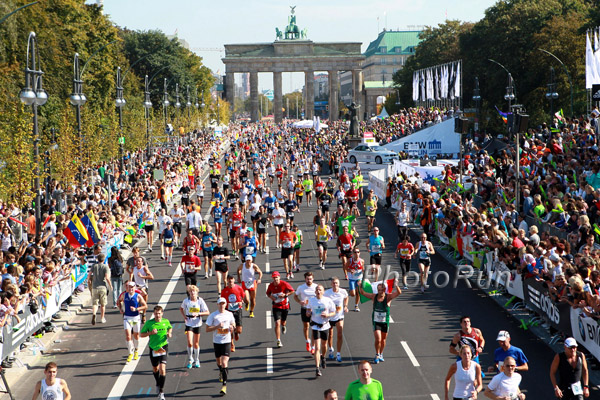
To be successful, it is important to find purpose in your running, whether it is to lose weight, improve your self-esteem or experience the international marathon phenomenon. Combined with the training schedule, this purpose gives you what you need to stand on the starting line next year at one of the world’s greatest marathon races, such as Berlin, Boston, Chicago, London, or New York. It is now up to you, to lace up your shoes and take the magic step out the door.
A few things beforehand: Running is healthy, brings you lots of fun and increases your overall fitness. Besides, running gives you a good figure. However, before you start running, please talk about it with your doctor and have a complete medical check-up. It is also important to get expert advice on running shoes, ideally from your local running store. For more general training information and other topics related to your marathon preparation, see General Guidelines for Your Marathon Preparation, one of Uta’s recent articles to help you in your training.
Do not put yourself under any pressure or become stressed out. The really long distance training runs will come at the very end of your preparations; by then, you will be well prepared and can master these distances.
One of the most common mistakes is to take off too fast. Doing so can result in becoming exhausted and losing your desire to continue. Therefore, it is best to begin carefully and slowly. When during a training jog you run out of steam, simply take a break and walk a while.
When you are in the preparation phase and cannot run for a week, do not worry—you still have enough time. Even if you lose a little fitness, you do not need to worry about making a fool of yourself in a major marathon like Berlin or New York. If you have problems along the way, you can always slow down and walk a while. Many more marathoners than you may think do just that. It does not matter what sort of pace you run—there will always be many other runners around you, and you will have the fun of a common marathon adventure together with them.
On marathon day, you will have lots of time to reach your goal. In the big marathons, you normally have more than seven hours to reach the finish line. That means averaging more than 15 minutes for each mile; if you are jogging at a slow pace, you will be much faster than that.
From the beginning of your training, set short-term goals for yourself. Small successes along the way are decisive and encouraging steps leading you to the starting line on the big day of your first marathon. After each training session, a genuine relaxation time is important. The first thing you should do after running is stretching, but make sure you stretch only after easy workouts! Then you may take a bath (not hot!) or go into the sauna. And always drink enough to rehydrate.
We have divided the year into four segments of three months each with the following emphases:
- acclimatizing phase,
- building-up phase,
- overall preparation phase, and
- special preparation phase.
Phase I Acclimatizing Phase (Three Months):
The most important step is to get out of the door! When you have done this, you can do the rest. At first, walk for 20 to 30 minutes at a fast pace two to three times per week. During the next two to three weeks, you can begin to jog slowly for one to two minutes, and then walk for one to two minutes. Keep alternating jogging and walking for 20 to 30 minutes. After some training sessions you can increase the jogging-walking intervals to 3 minutes each. The next step will be alternating four minutes of jogging and two minutes of faster walking, and then alternating six minutes of jogging and two minutes of fast walking. This is how you build up your endurance until you can, for example, jog for 30 or 40 minutes without stopping. At all times, keep your pace slow enough so that your breathing remains under control.
The first three months of your marathon training will help you to be prepared for the longer distances in Phase II, and at the same time provide a good opportunity to participate in 5K or 10K events. You can combine this plan with Uta’s 5K training schedule she provided accordingly to Phase I. Uta explained that the schedule is for those of you who haven’t run much recently or never ran before.
Phase II Building-Up Phase (Three Months):
You should now jog three to four times per week so that your weekly mileage and your endurance gradually build. Alternate between slightly challenging weeks and easier weeks with less mileage. For example, the longest run of a given week should be ten minutes longer than your previous longest run.
If two to three training weeks have gone well, take a recovery week—train just three times, and just run as you feel to keep fit. Occasional easy weeks like this help you to consolidate your recent endurance gains while you rest before starting another block of training.
One option is to color-code your schedule, the “green” days are your long, easy runs. The “red” days are your harder, faster workouts. Uta used this color-coding methodology throughout her career. See the bottom of the schedule for additional explanations of the various workouts in it.
Typical Week During Phase II
| Monday | Tuesday | Wednesday | Thursday | Friday | Saturday | Sunday |
| Beginning | ||||||
| Rest | 5 miles (s) | 4 miles (m-f) | Rest | 4-5 miles (s) or Rest | Rest | 7 miles (s) |
| End | ||||||
| Rest | 5-6 km (s) | 5 miles (m-f) | Rest | 5 miles (s) or Rest | 5 miles (m) | 7-9 miles (s) |
s = slow pace (your normal jogging pace)
m = medium pace (slightly faster than slow pace)
f = fast pace
s-m or m-f = increase your speed during a single training session. Run the first 25% of the distance slower than average. Then slowly increase your pace, and for 50% of the distance, run your average pace. For the last 25% of the distance, run faster than average.
Be very careful not to go too fast when increasing from one speed level to the next.
Phase III Overall Preparation Phase (Three Months):
The main goal of this phase is getting more endurance and speed. As with in phase 2, if two to three training weeks have gone well, take a recovery week—train just three times, and just run as you feel to keep fit.
Here too, the “green” days are your long, easy runs. The “red” days are your harder, faster workouts. See the bottom of the schedule for additional explanations of the various workouts in it.
Typical Week During Phase III
| Monday | Tuesday | Wednesday | Thursday | Friday | Saturday | Sunday |
| Beginning | ||||||
| Rest | 6 miles (s) | 5 miles (m-f) | Rest | 5-6 miles (s) | 6 miles (m) | 9 miles (s) |
| End | ||||||
| Rest | 6 miles (s) | 6 miles (m-f) | Rest | 6 miles (s) | 7 miles (m) | 12 miles (s) |
s = slow pace (your normal jogging pace)
m = medium pace (slightly faster than slow pace)
f = fast pace
s-m or m-f = increase your speed during a single training session. Run the first 25% of the distance slower than average. Then slowly increase your pace, and for 50% of the distance, run your average pace. For the last 25% of the distance, run faster than average.
Be very careful not to up your pace too quickly when increasing from one speed level to the next.
Phase IV Special Preparation Phase (Three Months):
This phase is about continuing to increase the total weekly mileage. For the last ten weeks of specific marathon training, try to follow the day-by-day plan as closely as possible. (You may switch the Friday and Saturday training sessions if you wish.) From the first to the eighth week, gradually increase your speed; do so especially during the Wednesday and Saturday sessions.
Again, the “green” days are your long, easy runs. The “red” days are your harder, faster workouts. See the bottom of the schedule for additional explanations of the various workouts in it.
The Last Ten Weeks Before a Marathon
| Monday | Tuesday | Wednesday | Thursday | Friday | Saturday | Sunday | |
1st | Rest | 6 miles (s) | 9 miles (m) | Rest | 6 miles (s) | 6 miles (f) | 16 miles (s) |
2nd | Rest | 6 miles (s) | 9 miles (m) | Rest | 6 miles (s) | 6 miles (f) | 16 miles (s) |
3rd | Rest | 5 miles (s) | 5-6 miles (s-m) | Rest | Rest | 5 miles (m) | 9 miles (s) |
4th | Rest | 6 miles (s) | 9 miles (m) | Rest | 6-7 miles (s) | 6 miles (f) | 16-19 (s) |
5th | Rest | 6 miles (s) | 9 miles (m) | Rest | 6-7 miles (s) | Rest | 16-19 miles (s) |
6th | Rest | 5 miles (s) | 5-6 miles (s-m) | Rest | Rest | 5 miles (m) | 9 miles (s) |
7th | Rest | 6 miles (s) | 9 miles (m) | Rest | 6-7 km (s) | 6 (f) | 19 miles (s) |
8th | Rest | 6 miles (s) | 12 miles (m) | Rest | 6-7 miles (s) | 6 miles (f) | 19 miles (s) |
9th | Rest | 6 miles (s) | 12 miles (m) | Rest | 5 miles (s) | 5-6 miles (m-f) | 7-9 miles (s) |
10th | Rest | 5 miles (s) | 5 miles (m, last 2 miles: f) | Rest | 30 min (s) | 20-30 min (s) | Marathon 26 miles |
s = slow pace (your normal jogging pace)
m = medium pace (slightly faster than slow pace)
f = fast pace
s-m or m-f = increase your speed during a single training session. Run the first 25% of the distance slower than average. Then slowly increase your pace, and for 50% of the distance, run your average pace. For the last 25% of the distance, run faster than average. Be very careful not to up your pace too quickly when increasing from one speed level to the next.
Updated November 23, 2013
Updated September 26, 2011
- Posted July 10, 2004
© Copyright 2004-2026 Dieter Hogen, Uta Pippig, and Take The Magic Step®. All Rights Reserved.