Cross-Country Skiing: A Great Option for Winter Fun and Fitness
Why Ski?
How and When to Ski
Where to Ski
With its beauty and peace, winter is a special time. It also is the season when you might want to start your journey to better fitness, or simply get back into your usual training routine. The colder winter months gave me the chance to do one of my favorite activities—cross-country skiing. If you love experiencing nature throughout the year, then I can’t imagine anything more lovely or idyllic than beginning the training year with some cross-country skiing. Just a little investment in equipment—and happy dreams of a luxurious hot chocolate after your training—can give you another wonderful opportunity for a fun, yet highly effective, workout. I would like to share with you some background information and tips for getting the most out of this beautiful winter sport.
Why Ski?
Many of you will be facing snowy, winter conditions as you prepare for one of the upcoming spring marathons. Cross-country skiing can provide a great alternative to some of your running workouts. It helps build stamina, endurance, and strengthen your running-specific muscles. Cross-country skiing also can prepare you mentally for the longer runs as you get closer to marathon day. Those oh-so-beautiful results of a snowstorm might deter you from your interval program or a tempo run outside—but you can stay within your planned training schedule with a similar workout on your cross-country skis.
Cross-country skiing also is ideal training for general fitness. And it can be used as an alternative to your regular training routine. If you begin your winter season with skiing, covering longer distances at low intensity will lay a foundation for running later. It also has been shown that skiing strengthens more muscle groups than running. Skiing gives stomach, back, arm, chest, and shoulder muscles a great workout. At a moderate intensity, you will burn roughly the same number of calories cross-country skiing for an hour as you would running for an hour.
Every year, I include cross-country skiing in my winter workouts to build endurance and muscular strength for my next phase of training which is aimed specifically at getting in good running condition. I choose skiing because it is a great complement to running and because the beauty and fun of exercising in a winter wonderland gives me new mental energy for the training year ahead. And it is such an exhilarating workout!
When I was preparing for spring marathons, I would do up to three weeks of skiing on very hilly terrain. It enabled me to go directly from this ski training to focused marathon preparation without interruption. Dieter Hogen, my coach for many years, used this method with his athletes. For years, junior runners he coached would do two weeks of cross-country skiing, then immediately switch to two to four weeks of running before the national indoor track championships. They had remarkable results, winning their races and setting personal bests. As was the case with me, these athletes said cross-country skiing left them mentally refreshed and feeling stronger. They also had less muscular soreness when they started their running-focused regimen.
Running history is filled with legendary tales of other athletes who thrived by cross-country skiing relatively close to a competition. Ingrid Kristiansen, a former world-record holder in the marathon, was known to ski throughout the winter in her native Norway. Because of an injury, American Bob Kempainen did much of his training before the 1992 Olympic Marathon Trials on a cross-country ski machine, and still finished in third place to make the U.S. Olympic Team for Barcelona.
Research supports anecdotal evidence that cross-country skiing provides a great workout. Stephen Seiler, Ph.D., is an exercise physiologist based in Norway who has studied (and competed in) running, cross-country skiing, rowing, and cycling. He notes that during cross-country races of 5 to 30 kilometers (3.1 to 18.6 miles), elite skiers work at as high a percentage of their cardiovascular maximum as do cyclists doing time trials and runners doing races of similar length.
In fact, Stephen Seiler reports, “some skiers will reach slightly higher heart rates during a race climb than during a maximal treadmill running test. What this tells us is that the top skiers are working at 100% [of their maximum] many times during a race. When a downhill segment comes, the heart rate drops, but not as much as you might think. Even though oxygen demand for downhill skiing is much lower, the skier doesn’t get much of a break. That heavy oxygen deficit accumulated during the climb is being repaid during the fast downhill, so heart rate may drop only 20 beats. Then we are on a flat. Now heart rate climbs again, to 10-15 beats below max.”
If you are suffering from an injury that keeps you from running, cross-country skiing might be an excellent substitute depending upon your specific injury. The movements involved in skiing offer all the familiar training virtues but, because you are not getting the jarring effect of foot strike as in running, it is easier on the joints. If you would like to give your tendons, ligaments, and joints a little break or if you need to stop running temporarily because of injury, you can do weeks of cross-country skiing (or skiing on rollers) without fear of missing out on your pre-season training or preparations for a marathon. Please seek the advice of your doctor before beginning preparation for a race or for trying a new sport or form of exercise.
How and When to Ski
The classic or traditional style of cross-country skiing is an outstanding training aid for developing strength and stamina. How you move is very similar to running. The leg swings forward, makes contact with the ground, then moves over the body’s center of gravity and drives off again. Cross-country skiing over undulating terrain with the weight of equipment, boots and skis, as well as the resistance of the snow, requires and develops a great deal of strength.
A training schedule for cross-country skiing is very similar to that for running, so you can use your basic running schedule—long workouts, intense workouts, recovery days, and so on. One change I make is that I spend more time skiing than on an equivalent running day. One reason is that you are gliding or going downhill for some of your ski session: you get little breaks you don’t get in running. A more important reason for spending more time is that I can—because there is less impact skiing, it is not as stressful on bones and soft tissue as running. I usually spend 50% to 100% more time skiing than running. On a day when I normally run for an hour, I will ski for 90 minutes to two hours.
There is another style of this enjoyable winter sport called freestyle or skate skiing, which has become much more popular. Many ski centers groom trails for skate skiing alongside the tracks for classic skiing. However, if your goal is to improve your running, then choosing the classic over the freestyle is highly preferable since you exercise similar muscles as in running. Although you do get a good workout with skate skiing, Stephen Seiler notes, “Heart rate, perceived exertion, and lactate accumulation are all lower at similar levels of intensities while skating compared to diagonal striding.”
A good support for cross-country skiing can be a light yoga stretching program. The two activities complement each other well. You can take the peace and serenity you find on a beautiful winter trail and apply it to yoga, and vice versa. Our Yoga for Performancesm program can be a great starting point for a practice that will help your skiing. The sequence of yoga exercises you will find in the related articles, will be most effective when practiced after easy days of skiing similar to after easy days of running. Please make sure you wait for a minimum of 4 to 5 hours after an intense skiing workout, before a yoga stretching routine. This will allow your muscles to recover from their exhaustion.
As for clothing, on cold snowy days there is little difference in what you need to wear for skiing or running. Depending on the session, whether it is a very long ski or a shorter and more intense session, and what the weather is like: you will need gloves, a ski hat, sunglasses, a tracksuit top and, above all, leggings to protect your thighs against the wind.
Nutrition and hydration are important. It is recommended that you drink more fluid (see our article “Water [Part1]: The Essence of Life“) and take in enough carbohydrates. This suggestion is not just good for runners, but is essential when you are out on a long cross-country ski session.
Whenever you decide to cross-country ski take some important safety measures: tell family or friends where you are going to ski, check the weather before you begin, bring extra gloves in case it is very cold, and use sunscreen to protect your skin. Have a cell phone and some emergency money with you when you explore the winter wonderland. If you are a newbie to cross-country skiing, it will be beneficial to practice skiing with an instructor, and start with an easy, flat course and stay on familiar trails. Later, when you are a stronger skier, you might move on to discover some of the more challenging courses with their up-and-down hills. Please, be careful when you ski! Check out a new course at a slower pace before you tackle it at moderate speed. Always be on the safe side!
I hope you have a great time, whether you are joining a group of cross-country skiers, doing long sessions or taking part in exciting competitions. Relish every moment of skiing amid the snowy landscape… perhaps enjoy some mulled wine or hot chocolate in a ski hut afterwards or back at home. To crown the experience, why not go for a sauna, rubbing yourself down with snow between hot and cold baths.
Where to Ski
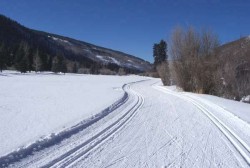
Basically, anywhere with snow! If you live in a cold weather winter climate, with a little cooperation from Mother Nature you may be able to find plenty of places close to home for traditional cross-country skiing—running trails, bike paths, golf courses, sometimes even your own neighborhood. Groomed trails are usually easy to find, too, and many sites offer a season pass for less than $100. If the climate you enjoy at home is more temperate, here are some suggestions for an enjoyable skiing holiday.
In the U.S.
The Devil’s Thumb Cross-Country Center, in Winter Park, Colorado, has 120 kilometers (74.6 miles) of trails designed for both skating and gliding style. The routes give wonderful views of the Rocky Mountains. Snow Mountain Ranch offers 100 kilometers (62.1 miles) of prepared trails in open, wooded, hilly or flat terrain, including a 3-kilometer circuit lit for night skiing. This area is 8 miles west of Winter Park. Check the Colorado Cross Country Ski Association Website for more information.
Located a short drive from Lake Tahoe, California, the Royal Gorge Resort has the largest groomed track system in North America, with more than 200 kilometers (124.3 miles) of trails. You will be assured of a good workout, because the resort is located at 7,000 feet of altitude in the Sierra Nevada mountains. Warming huts along the trails sell soup, hot chocolate and other snacks for when you need a breather. For more information, visit the Royal Gorge Website.
The Craftsbury Outdoor Center, in Craftsbury Common, Vermont, was voted one of the ten best groomed skiing sites in North America by the members of the U.S. national team in the past. Situated in northeast Vermont, the center guarantees snow from January through early March, and puts on several well-attended races. Craftsbury’s dining hall is famous for serving healthful vegetarian fare made primarily from local ingredients. See the Craftsbury Center Website for more information.
See the Website of Cross Country Skier for more locations in the U.S.
In Europe
Seiser Alm in the Italian South Tyrol offers wonderful conditions for cross-country skiers. The biggest high plateau in Europe with 55 square kilometers (21.2 square miles) at an altitude of 1,700 meters (5,577 feet) has about 60 kilometers (37.3 miles) of man-made tracks for classic and freestyle. Seiser Alm also has alpine ski lifts. If anyone wants demanding alpine pistes as well as cross-country circuits, Monte Pana is the place. The region is reached easily from the hustle and bustle of the Super Dolomites and offers about 25 kilometers (15.5 miles) of long-distance tracks. In addition, the routes are only a few kilometers away from the cross-country tracks of Seiser Alm, which is well known as a ski region that gets plenty of sunshine and has spectacular views of the Dolomite mountains. Check the Superski Website or go to www.AlpeDiSiusi.info for more details.
If you want to try Nordic skiing in its homeland, we recommend the following options: Sälen in Sweden, Lillehammer in Norway, or Levi in Finland. At each of these destinations you will find a huge network of cross-country ski trails.
—
Cross-country skiing can be fun for the entire family and is suitable for all skill levels — from the beginner to the Olympic athlete. You might discover it only takes a short time to fully enjoy gliding on cross-country skis on these beautiful trails — while you get a full body workout in the middle of the winter’s magic.
With many exciting cross-country skiing events in full swing, we wish all athletes the best of luck in their competitions. For those who follow some of them on TV, there will be lots of reasons to watch the great and gripping skiing events. Maybe YOU will be inspired by these outstanding performances to try clipping on your skis on a sunny winter day and following the trails through the glittering snow.

Reading Suggestions:
- For information on other winter sports, you may view our article: “Skiing and Snowboarding: Risks and Many Rewards“
- Periods of Training for Your Marathon Preparation and Distance Progression for Your Long Runs
- Key Training Principles for the First Build-Up Period of Your Marathon Preparation
- Training Advice for the Second Build-Up Period of Your Marathon Preparation
Updated December 11, 2016
Updated December 2, 2014
Updated January 16, 2010
Posted December 2006
- Posted December 10, 2015
© Copyright 2006-2026 by Uta Pippig. All Rights Reserved.