Uta Pippig: Sharing the Joy
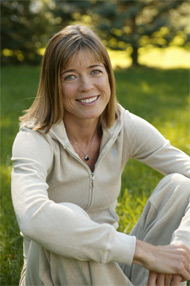
Uta became a world-renown runner as she won three consecutive Boston and Berlin Marathons, and the New York City Marathon. In the process, she endeared herself to fans with her smile and the kisses she blew to the crowds on her way to the finish lines.
“The joy of running always has inspired me, and I wanted to share my excitement and make the spectators a part of the joy I was feeling,” she explained. “It was my way of saying ‘Thank you,’ because I always felt that the energy I drew from the crowds helped me run to my limit.”
Now Uta channels the joy, passion, and discipline she brought to world-class competition into Take The Magic Step®. The organization includes the health and fitness programs she developed, coaching individuals and groups, and the Take The Magic Step™ Foundation, a charity for helping underprivileged people, particularly children, around the world. Uta is a sought after public speaker for her series, “Running To Freedom™.” She is a columnist for the newspaper Die Welt and is an ambassador for the Berlin Marathon.
Uta has known heartbreak as well as triumph. Her departure from the unstable political dictatorship in East Germany… the victory in the “Reunification Marathon” in 1990 that spanned from West Berlin through the Brandenburg Gate into East Berlin… an unknown pelvic stress fracture that forced her to drop out of the 1996 Olympic Marathon when she was leading the field… and the challenges that come along with starting a business.
Most important to Uta is her partnerships with charitable organizations that promote education, fitness, and health through her Take The Magic Step Foundation.
The Early Years
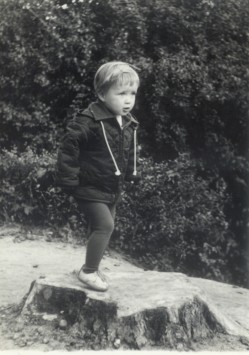
Uta was born on September 7, 1965 in Leipzig, East Germany. Once home to Bach and Goethe, it was also the site of the mass demonstrations that ultimately led to the fall of the Berlin Wall. Uta lived there until she was almost four, when her parents, who were young doctors, moved the family to a town in the countryside outside Berlin.
Her parents influenced her deeply, teaching her the value of approaching a task with purpose, persistence, and resilience — all characteristics that are invaluable, particularly to an endurance athlete.
When she was 13, a girlfriend invited her to join “TSG Blau-Weiß Petershagen,” a youth sports club in her hometown. The elite clubs recruited from these “farm” clubs, making them the foundation of the East German sports system.
Uta showed great promise, but her parents, intent on her becoming a doctor, hoped she concentrate on her studies. As Uta explained, “My parents did not see me as the Olympic athlete I dreamed of becoming.”
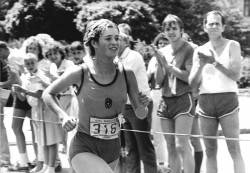
But she was a natural and she excelled. “The joy of running always has inspired me,” she said. She seldom focused on her pace, she remembered, except when she was being timed. It was more important to enjoy the experience. She ran on the streets, on hilly cross-country trails, on flat forest trails, and — her favorite — at the beach during summer vacation.
“It’s the same for anyone today,” she said. “You only need a pair of running shoes, somewhere to run, perhaps a friend to jog with, and a little love of being outside and in nature.
Her coach also organized running games, which kept everyone motivated. “These were special days, when I reflect back,” Uta said. “I just went out and raced with my team mates — dressed in cotton shorts and shirts, and wearing canvas shoes. It was a world away from today’s high-tech gear. We ran for the love of it. I often call upon those times to remind myself of the special qualities of running and why I love it so much!”
Her Early “Run” to Freedom
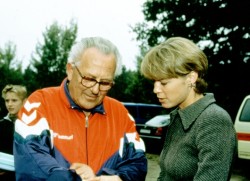
In March of 1983, Uta was recruited by one of the top sports clubs in East Germany, the Army Sports Club in Potsdam, known as ASK. There, in 1986, she met Dieter Hogen. He has been her coach and good friend ever since. Under his tutelage and with a great deal of hard work, she became one of the most successful long distance runners in East Germany. But despite the successes, the oppressive political system didn’t allow them to travel together to the West for competition or pursue the training system she and Dieter envisioned.
They contemplated defecting, but the risks were too great. Finally, in January 1990, they couldn’t wait any longer. The Berlin Wall had “fallen” in November, but the Communist Party was still in power and the boundary between East and West Berlin still existed. As political change loosened the rules more and more, still, as a member of the Army Sports Club, Uta would be considered a military deserter if she left East Germany.
“The most challenging race of my life wasn’t actually a race. It was a journey that began in East Berlin on an early January morning in 1990 and ended in West Germany—where freedom and opportunity awaited,” she revealed. “Most marathoners have to worry about ‘the wall’ that silently appears somewhere around the 20-mile mark in a marathon. The wall I faced was 15 feet high, made of steel-reinforced concrete, and topped with barbed wire. It was still manned by troops stationed in watch towers, armed with machine guns and with guard dogs by their sides.”
On January 5, 1990, almost penniless, Uta and Dieter drove a small car across the border between East and West Germany. They had no problem crossing the border, albeit literally with not much more than the clothes on their backs. Three months later, the first free elections were held, and the people of East Germany voted out the Communist Party. As a result, a general amnesty was declared. Uta was no longer a deserter — she was free.
Medical Student or #1 Marathoner?
Uta’s parents had a dream, too — that their daughter would become a doctor, like them. And from 1990 to 1994, continuing her studies she began in East Berlin’s Humboldt University, Uta juggled both her medical studies at the Freie Universität in West Berlin (Free University in Berlin) and world-class running competition. “That’s when I gained an understanding of the lives of so many women who face the challenge every day of fitting in two or more demanding jobs,” she explained. “They work 9 to 5, then come home to cook for their families and raise their children. It is so hard. Finally, I knew I had to choose between medicine and running — but at least I was lucky enough to have a choice.” She decided to focus solely on running. It would lead to a headline-making string of victories achieved with the humble grace that made Uta a role model for a generation.
Boston: The Holy Grail
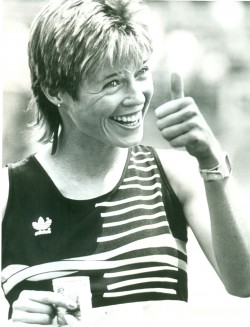
From behind the Iron Curtain, Uta could only imagine the excitement and drama of the world’s oldest and most revered marathon — Boston. “I pictured it in my head, imagined over and over what it would be like to run there. But I was on the wrong side of ‘The Wall,’ and it was a dream I thought would never come true.”
But three months after she and Dieter drove into West Berlin her dream was realized. In April 1990 she stood on the starting line in Hopkinton along with the best women runners in the world. Uta finished second, behind the great Portuguese World and Olympic champion, Rosa Mota. But no one who witnessed her gutsy performance that Patriots Day doubted that a new star had been born.
Later that year Uta won the “Reunification Marathon” in Berlin. The race served as a symbol of freedom to the millions of former East Germans who had dreamed of the day liberty would become a reality. Winning this prestigious race remains one of her most emotional and gratifying victories. Together with 25,000 other runners she had the extraordinary experience of running from the former West Berlin through the historic Brandenburg Gate into what had been East Berlin. “It’s a moment that I will cherish for as long as I live, and I feel fortunate to have shared that special occasion with so many,” she said.
Uta had won two Berlin Marathons and had set up home in Boulder, Colorado, when she went to New York City in the fall of 1993. There she became the only German to win the New York City Marathon. She controlled the race from Mile 11 and crossed the line in Central Park on a warm day in 2:26:24 hours.
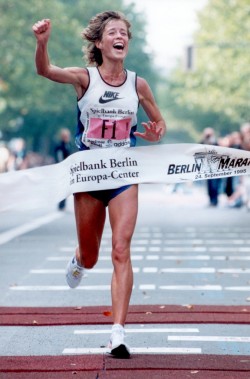
But winning the Boston Marathon was always her Holy Grail, her symbol of the freedom of the West. Five months after her New York win, Uta wiped out the memory of the defeat by Rosa Mota, winning the 1994 Boston Marathon in a course record time of 2:21:45. In 1995, she was crowned Queen of Boston again and became a legend in New England. But there was more to come.
1996: The Famed Boston Race, The Olympics and Heartbreak
One year later in 1996 — on the 100th anniversary of the venerable race — she joined the best in the world, becoming the first woman to officially win the Boston Marathon three consecutive times. The race was one of the most memorable events in sports history.
No one who witnessed her courage that day will ever forget it. Beset by embarrassingly visible problems and suffering severe intestinal pain, Uta considered dropping out as early as the fifth mile. Finally, at 7.5 miles, her body refused to go on, and she had to stop running and walked a few steps.
But that was not the end of the story that day in Boston.
With fans providing water to clean herself and urged on by the adoring crowd, Uta started forward again, step by step, mentally drawing on her parents’ teachings of resilience and perseverance. Ever increasing her pace, she dramatically came from 220 yards behind in the final miles to pass Kenya’s Tegla Loroupe — and won the race in 2:27:12. Immediately afterwards, she was hospitalized for treatment of ischemic colitis for several days.
The Boston Globe’s Dan Shaughnessy, a dean of sports writers, marveled, “She was Carlton Fisk after clanging a homer off the left-field foul pole. She was Larry Bird after stealing Isiah Thomas’ pass to beat the Pistons. She was Bobby Orr flying through the air after beating the St. Louis Blues to win the Stanley Cup.”
Uta was at the pinnacle of the sport and her career. She was voted Runner of the Year by the Association of International Marathons and Road Races (AIMS) in both 1995 and 1996. And she was ranked #1 in the world in 1994 and 1995 in both the marathon and the half marathon.
But then fate intervened. Months after her third Boston triumph she was the favorite to win the 1996 Olympic Marathon in Atlanta. She was leading the race when pain increasingly shot through her legs. In agony from what was later diagnosed as stress fractures in her pelvis and her right tibia (shin), she fell back to 8th place. She was forced to drop out of a race for the first time in her life. The experience was devastating. “It was a nightmare to have to drop out of a race for the first time — especially at the Olympics. At first when the pain hit me, I thought I could still run well enough to win a medal. But, I was wrong. I ran with my heart and not my head — which made the injury worse. I had to depart the race with just 7K to go.”
Suddenly, Uta, always a champion at heart, found herself dealing with illness and injury that would keep her from training properly. In summer 1997, another injury surfaced, and she finally was forced to have complicated foot surgery. Despite of a superb surgical team the extended and long running hours needed for top marathon training were no longer possible due to her weakened foot.
In spring 1998 as Uta slowly recovered from her medical problems and was on the road back to running, a random non-competition drug test found that her Testosterone/Epitestosterone (T/E) ratio was slightly above that allowed at the time. Although the tests found no banned substances in her system, and for her profile low levels of testosterone, the German Track and Field Federation (DLV) was forced to enact a suspension. The matter went to review and arbitration, where ultimately it was dropped after two years. Read more
In spite of doctors attributing the T/E ratio to Uta’s low levels of epitestosterone caused by active bowel disease, the ordeal was deeply troubling to Uta and triggered bouts of depression. They were only conquered with medical help and the ardent and unwavering support of her family, friends, fans, sponsors, and the media.
2000: Returning to Running
Between 2000 and 2002, Uta returned to good health and a renewed zest for running. In 1999, she had been accepted as a member of USA Track and Field and competed in road races worldwide.
Uta continued to realize her potential as a competitive athlete, turning her focus to shorter distance Masters races in 2005. Today, she enjoys participating in running, biking, and triathlon events, most of them for charitable causes. She also joins in training runs and bike tours with her friends and clients, often using these events as part of her seminars “Running To Freedom™.”
2004: Sharing the Dream — The Philosophy of Take The Magic Step
In 2004, adding a new chapter to her athletic career and life, Uta formulated a program that allows her to share her love for the sport and her enthusiasm for running and fitness. “I saw people struggling with what came naturally to me and I became convinced I could help them.” she said. “I formulated the fundamental aspects for the philosophy of Take The Magic Step® through which I share my appreciation of our freedom and my love of exercise, the outdoors, and healthy nutrition. What I had been through gave me the vision to help others as I continue to learn from people who inspire us.”
For her Take The Magic Step audience, Uta provides a bridge to a healthier and happier life. “I hope I am able to inspire people whose lives may be on a downturn — because I’ve been there,” she said. “Each of us is unique. I learn so much from every person I meet. I try to see beyond the expression on their faces, to catch a glimpse of their dreams — but also their struggles and worries. When someone is in need I see their inner beauty and I am in awe.”
2006: The Launch of Take The Magic Step®
Uta’s understanding of the complex and intriguing relationship between one’s physical and mental wellbeing enables her to share her ideas and theories with others. One cornerstone of her presentations, seminars, and writings was inspired by this quote from the Roman poet Juvenal: “Mens sana in corpore sano” — A healthy mind in a healthy body.”
Through the Take The Magic Step Website she shares her experience and her ongoing research by giving participants clear and succinct information. She hopes to save them from having to navigate the jungle of often-conflicting health facts found in articles, news stories, books, and other online resources.
Her program emphasizes five core values: inspiration, exercise, nutrition, yoga, and health management, and focuses on providing people with a gentle, tailored, and practical path toward a healthy lifestyle. Uta has operated the Website since 2006 as a writer and editor-in-chief, leading an international team of contributors. She calls the team “my family and I owe my deepest gratitude to them for contributing their support and inspiration to me over the years.” The Website’s mission is to help those who want to enhance the quality of their lives with the emphasis on a greater sense of wellbeing achieved and maintained through a combination of inspiration, education, and patience.
She shaped the content to appeal to nonprofits, schools, companies, athletes, and non-athletes alike.
2008: Take The Magic Step Foundation
As Uta shifted her focus away from that of a full-time professional athlete of great importance to her was the freedom to spend more time helping others and to be dedicated to her work with her charity partners. In early 2008, together with Michael Reger, she established the Take The Magic Step Foundation™ to expand the ability to help children and adults facing health or economic hardships.
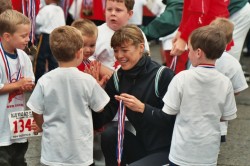
Uta said: “I have always believed, and still do, that love, warm-hearted care, sensitive empathy, and light words of understanding, combined with the right interest and knowledge, can move mountains. I hope to gracefully share a common goal with others who seek a happier, more satisfying, and healthier lifestyle.”
She strengthens her bond with her fans and fellow runners through charity affiliations that are very special to her. They include the Dana Farber Cancer Research Program (Jimmy Fund) in Boston, where she visits with the children and gives motivational talks, the leadership initiatives of the SOS Outreach Programs in Colorado, and the educational programs of Louisa May Alcott Orchard House in Massachusetts.
For many years Uta was coaching the runners of the Hoyt Foundation in preparation for the traditional Boston Marathon in support of the mission of the amazing father-son-duo Dick and Rick Hoyt to raise awareness of, and help, the physically challenged. She is supporting the Kinderhilfe Petershagen-Eggersdorf e.V. in her hometown in Germany, a charity near Berlin that supports children who are lacking basic necessities including school supplies, transportation or means to attend after-school activities, and also organizes summer holiday camps for the children of the victims of Chernobyl.
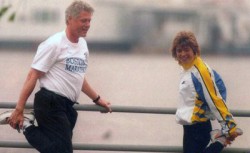
She said: “The needs of these wonderful organizations push me to do as much as I can for those who are not as fortunate as we are.”
While running with President Clinton and appearing on programs like “The Late Show with David Letterman” were joyful and fun experiences. Closest to her heart are her motivational speeches, her coaching of the runners of the Hoyt Foundation in support of Team Hoyt, her corporate engagements, and appearing at the events of her charities partners in support of children, fitness, and education.
2012: “Running To Freedom™” Speaking Series
In late summer of 2012, Uta launched her speaking series, “Running To Freedom™.” In these history-inspired presentations she explores the desire for change and discovers together with her audience the fundamental tools needed to help them to be the best they can be and, along the way, draws parallels to their life experiences.

She uses her own journey to freedom as a framework for inspiration, and explores the value of freedom, and how it can be recognized within anyone and how it can become part of THEIR journey to reach desired goals — emotional, physical, or mental — one small step at a time.
“What I most cherish is the freedom many of us can live in,” says Uta. “And sharing what I’ve learned — with lessons of heartbreak and triumphs, suppression, and freedom. I hope that one of my vital life beliefs, ‘The Belief That Change Is Possible.’ can be used as a joyful and helpful guide for people who want to move towards a healthier and more balanced life. There shall be joy in one’s approach, or change becomes more difficult.”
2016: Columnist, Writer, Author

In 2016 Uta began writing columns for the German newspaper “WeLT” and in November 2017 she became a columnist for the German running magazine “Laufzeit & Condition.” She also started collecting “Letters to a Friend” in anticipation of writing a book in the near future.
2017: Fitness and Running Expert to the Berlin Marathon
In 2017 the Berlin Marathon honored Uta by making her the first woman inducted into the Berlin Marathon Hall of Fame and asking her to be an ambassador for the marathon. She is now working together with the marathon medical team to promote fitness, training, and health. In 2017 Uta also ran the Berlin Marathon “to be out on the road with all the wonderful runners, and to hopefully inspire them to the finish line.” And she is supporting the children’s events each year during the Berlin Marathon weekend.
2020 and 2021: Virtual Runs, Her Book, and A New Passion
With the challenges of the pandemic and following cancellations of events, speaking engagements, and training sessions, Uta turned to exploring additional avenues to pass on her passion for running, fitness, longevitiy, and charitable givng. She is enjoying virtual charitable running and is writing her book, “Running To Freedom™,” with the encouragement of publishing houses in both Germany and America. The book encompasses her own journey to freedom and the philosophy that we can embrace the freedom both as a society and as a person to make choices that can lead to healthier and happier lives. And she rediscovered another passion: photography. She is looking foward to implement the art into her book and speaking sessions by expressing her deep love of nature in conjunction with her love of running. You can find some of her work on her Website and on Instagram “Uta Pippig Photography.”
Some of Uta’s Career Highlights
Take The Magic Step® is Uta’s way of life and the vehicle she created to listen to people and to mentor them. It incorporates who she is, her history, what she has learned, and what she hopes to share. As Uta says, “…maybe one day you will come across me with some friends on a forest trail experimenting with running techniques or on a grass track running diagonals barefoot or on a mountain path hiking towards the sky, laughing and chatting away—feeling free.”
- Winner of the Berlin Marathon — 1990, 1992, and 1995
- Winner of the Boston Marathon — 1994, 1995, and 1996
- Winner of the New York City Marathon — 1993
- Runner of the Year by the Association of International Marathon and Road Races (AIMS) 1995 and 1996
- Ranked #1 in the world 1994 and 1995 in both the marathon and the half marathon
- Former German record holder in the marathon: 2:21:45 (2 hours, 21 minutes, and 45 seconds). Recorded at the 1994 Boston Marathon. It was the third-fastest marathon result ever by a woman at that time.
- Former German record holder in the half marathon: 67:58 (67 minutes and 58 seconds). Recorded at the 1995 Kyoto Half Marathon on March 19, world record at that time until March 9, 1997. The time stood for 25 years as the German Record.
- Olympic Games: 7th in the 10,000 meters, Barcelona, 1992; pelvic and tibia stress fractures, DNF in the marathon, Atlanta, 1996
- World Championships: 6th in the 10,000 meters, Tokyo, 1991; 3rd in the 15K, Nieuwegein (NED), 1991; winner with the German team in this event
- Indoor World Record in the 5,000 meters, Stuttgart, 1991 (15:13.72 — 15 minutes and 13.72 seconds)
- Winner of numerous road and cross-country races, and Masters competitions (40+) worldwide. She also participated in triathlon events.
- Founder, Take The Magic Step, LLC (2004)
- Co-Founder, Take The Magic Step Foundation (2008)
- Contributing writer for TODAY Health online, The Boston Globe, German Runner’s World, and other publications
- Columnist for the German newspaper WELT (December 2016-present)
- Columnist for the German running magazine Laufzeit & Condition (November 2017-present)
- Ambassador for running, fitness, and health for the Berlin Marathon (2017-present)
- Broadcast analyst, Boston Marathon; Berlin Marathon
- Colorado Running Hall of Fame, Class of 2015
- Berlin Marathon Hall of Fame, 2017
- Coach for Dick and Rick Hoyt’s Boston Marathon teams (2008 to 2015)
- ReBrand 100 Award, 2006, Take The Magic Step
- MIT AgeLab in Boston (2005 to 2009)
Updated May 2021
© Copyright 2004-2026 by Uta Pippig and Take The Magic Step®. All Rights Reserved.